
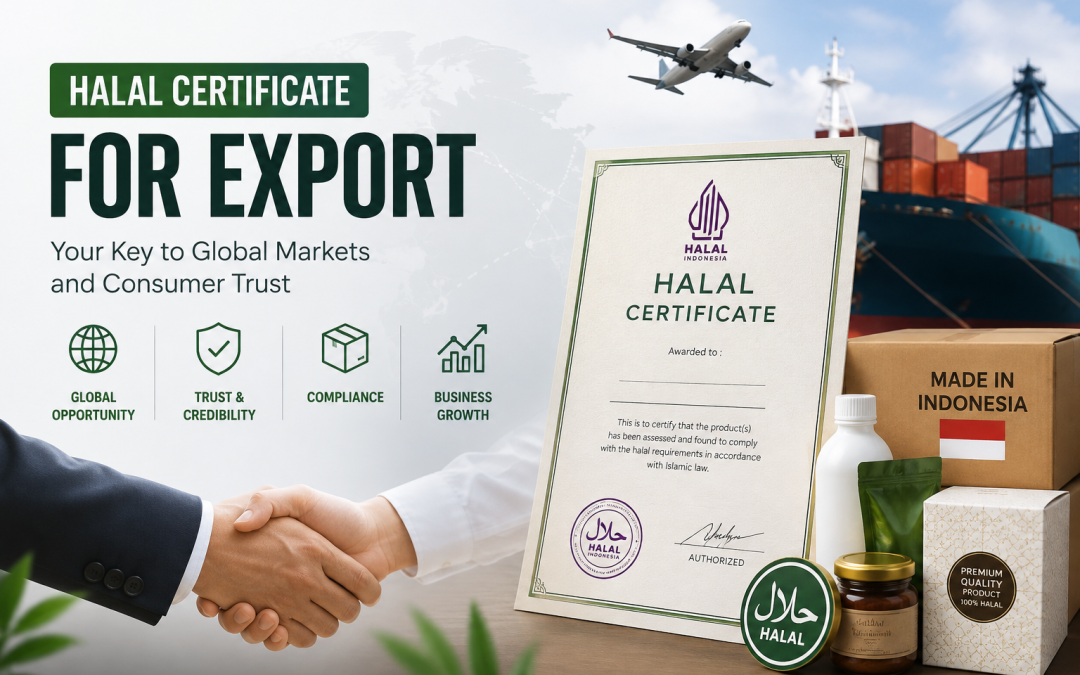
Is an Indonesian Halal Certificate Valid Overseas?
An Indonesian halal certificate does not automatically apply in every export destination country. Its validity depends on the regulations of the destination country and the existence of a recognition mechanism or cooperation arrangement between the relevant halal authorities.
Under Indonesia’s Halal Product Assurance (Jaminan Produk Halal or JPH) system, international cooperation may be established for the development of JPH, conformity assessment, and recognition of halal certificates. This provision serves as an important basis for establishing the acceptance of Indonesian halal certificates in international markets.
Article 47 of Law No. 33 of 2014 on Halal Product Assurance (“Halal Product Assurance Law”) primarily regulates foreign halal products entering Indonesia. This Article provides a mechanism for recognizing foreign halal certificates through mutual recognition arrangements and registration with BPJPH.
Meanwhile, the provisions more directly relevant to international cooperation are set out in Article 46 paragraphs (1) and (2) of the Halal Product Assurance Law, which provide that:
The Government may establish international cooperation in the field of JPH in accordance with the applicable laws and regulations.
International cooperation in the field of JPH may take the form of JPH development, conformity assessment, and/or recognition of Halal Certificates.
These provisions are further elaborated under Government Regulation No. 42 of 2024 on the Implementation of Halal Product Assurance (“GR 42/2024”). GR 42/2024 regulates international cooperation in the recognition of halal certificates through a mutual recognition mechanism. Halal certificates issued by foreign halal institutions may be accepted based on reciprocal mutual acceptance agreements.
This means that a halal certificate issued by BPJPH can form part of an international recognition mechanism. However, exporters must still verify whether the destination country has established a recognition mechanism for such certificates. For a broader overview, exporters may review Indonesia’s halal certification legal framework and global market strategy.
For example, Indonesia and Saudi Arabia have established cooperation on the mutual recognition of halal standards through BPJPH and the Saudi Halal Center under the Saudi Food and Drug Authority (SFDA). Such cooperation can help increase the acceptance of Indonesian halal products in the target market.
Is Indonesian Halal Certification Enough for Export?
For exporters, obtaining an Indonesian halal certificate is an important step. However, the certificate may not be the only requirement for entering the destination country.
Article 4 of the Halal Product Assurance Law stipulates that products entering, circulating, and being traded within Indonesia must be halal-certified. This provision demonstrates that Indonesia’s halal certification obligation primarily applies to products within the Indonesian jurisdiction.
When products are intended for export, exporters must also consider the laws of the destination country. Requirements may include halal certification, recognized certification bodies, the use of halal logos, and specific requirements based on the type of product. Exporters of branded products may also benefit from trademark protection strategies for exporters to protect product identity abroad.
The Assessment Institute for Foods, Drugs, and Cosmetics (LPPOM) explains that halal requirements for exports may arise because the destination country has a large Muslim population. Such requirements may also apply because the product is used as an ingredient in halal production or because of specific regulations governing logos on packaging.
Therefore, exporters should not assume that a BPJPH certificate automatically satisfies all requirements in the destination country. Halal export compliance must be viewed as a combination of Indonesian standards and the regulations applicable in the destination market.
Differences in standards are also among the challenges facing the development of Indonesia’s halal industry. The National Committee for Islamic Economy and Finance (Komite Nasional Ekonomi dan Keuangan Syariah or KNEKS) emphasizes the importance of international cooperation, including mutual recognition of halal standards and certification.
Accordingly, exporters should conduct regulatory mapping before shipping products. This step helps companies determine whether a BPJPH certificate can be used directly, must be registered, or requires additional certification.
Halal Compliance Strategies for Exporters
Exporters can implement the following legal steps to increase the likelihood of their products being accepted in international markets.
Identify the Regulations of the Destination Country
The first step is to identify the halal regulations applicable in the export destination country. Exporters need to understand the relevant halal authority, recognized certification bodies, and the types of products subject to halal requirements.
Differences in requirements between countries may affect the certification process and the documents that must be prepared. Therefore, regulatory mapping should ideally be conducted before entering into an export contract and shipping the goods.
Ensure the BPJPH Halal Certificate Is Valid
Exporters must ensure that their products have a halal certificate issued by BPJPH in accordance with Indonesian requirements. The certification can serve as a basis for satisfying halal requirements while enhancing product credibility.
BPJPH also notes that halal certification can provide added value for businesses. Some micro and small enterprises (UMK) have even successfully entered export markets after obtaining halal certification.
Check the Mutual Recognition Mechanism
If the destination country has a mutual recognition arrangement with Indonesia, exporters should examine the scope of the arrangement. The review should cover the certificate-issuing institution, product categories, applicable standards, and recognition procedures.
GR 42/2024 identifies mutual recognition cooperation as one of the instruments for recognizing international halal certificates. General guidance on market entry is available in a simple guide to the legal requirements for exporting your business.
Adjust Export Labels and Documentation
Halal requirements do not necessarily end with certification. The destination country may impose requirements concerning the use of halal logos, product information, labeling, or other supporting documents.
Exporters must ensure that the information on the packaging is consistent with the certification documents. Inconsistencies may result in administrative or trade-related obstacles.
Establish a Product Traceability System
Halal compliance should not be limited to the certification application process. Companies need to maintain consistency in materials, production processes, storage, packaging, and distribution.
This strategy is consistent with efforts to strengthen the Halal Value Chain and implement certification and traceability systems as part of Indonesia’s halal industry development strategy.
Conduct a Legal Review Before Exporting
Before entering a new market, exporters should review all halal requirements applicable in the destination country. The review may cover certificate status, recognition mechanisms, labeling, distributor agreements, and documentation obligations.
This approach helps companies anticipate the risk of product rejection. It also enables exporters to determine from the outset whether additional certification or registration will be required. Such reviews are part of the licensing and compliance services available for companies operating across jurisdictions.
Conclusion
An Indonesian halal certificate is an important instrument for building product trust and competitiveness. However, a BPJPH certificate does not automatically apply in every export destination country.
The acceptance of a halal certificate depends largely on the destination country’s regulations and the applicable mutual recognition mechanism. Therefore, exporters need to combine compliance with Indonesian requirements with compliance with the halal regulations of the destination country.
Through regulatory mapping, review of recognition mechanisms, appropriate documentation adjustments, and a proper legal review, halal certification can become part of a safer and more sustainable export strategy.
For businesses preparing their products, SIP-R Consultant provides halal certification and business licensing support. Ensure that your halal certification and product documentation comply with export requirements before entering international markets.
Legal Basis
- Law No. 33 of 2014 on Halal Product Assurance (“Halal Product Assurance Law”)
- Government Regulation No. 42 of 2024 on the Implementation of Halal Product Assurance (“GR 42/2024”)
References
- BPJPH — Kabar Baik bagi Eksportir, BPJPH dan Saudi Halal Center SFDA Sinergi Saling Pengakuan Standar Halal
- LPPOM — Mengapa “Halal” Dipersyaratkan untuk Negara Tujuan Ekspor
- KNEKS — Harmonisasi Standar Halal Jadi Kunci Perdagangan Indonesia, Pakistan, dan Iran
Frequently Asked Questions
Does an Indonesian halal certificate automatically apply overseas?
An Indonesian halal certificate issued by BPJPH does not automatically apply in every export destination country. Its acceptance depends on the destination country’s regulations and the existence of a mutual recognition arrangement between the relevant halal authorities. Exporters should therefore verify whether the destination country recognizes BPJPH certificates before shipping their products.
What is mutual recognition of halal certificates?
Mutual recognition is an arrangement in which two countries accept halal certificates issued by each other’s authorized halal institutions. Under GR 42/2024, halal certificates issued by foreign halal institutions may be accepted based on reciprocal agreements. Indonesia and Saudi Arabia, for example, have established such cooperation through BPJPH and the Saudi Halal Center. Recognized certificates reduce the need for repeated certification in the destination market.
Is an Indonesian halal certificate enough for exporting halal products?
Not necessarily. Law No. 33 of 2014 obliges products traded within Indonesia to be halal-certified, but export destinations may impose additional requirements. These can include recognized certification bodies, the use of halal logos, labeling rules, and product-specific standards. Exporters must therefore comply with both Indonesian law and the regulations applicable in the destination country.
What should exporters prepare before entering a new market?
Exporters should conduct regulatory mapping before shipping. This includes identifying the halal authority in the destination country, checking whether BPJPH certificates are recognized or require additional registration, verifying logo and labeling rules, and establishing a product traceability system. A legal review covering certificates, recognition mechanisms, and documentation obligations helps companies reduce the risk of product rejection.
Halal certification for export requires careful coordination between Indonesian requirements and the regulations of the destination country. Consult SIP-R Consultant regarding your business’s halal compliance needs before entering international markets, or discuss your export compliance concerns with SIP Law Firm.